
Best Event Planner Website Templates to Book More Clients in 2026
If you’re an event planner or party stylist who’s been relying on Instagram and word of mouth to book clients, this post is for you. You’ve probably thought about building a website a hundred times, maybe even started one and abandoned it. Or maybe you’ve looked into hiring a designer and realized the price tag just isn’t realistic right now. That’s okay. You don’t need a $5,000 custom website to start showing up online and booking better clients. What you do need is a website that works, and a template is one of the smartest ways to get there.
This post is a little different from our other template roundups. Instead of jumping straight into which template to pick, I want to talk about something bigger first: why having a website matters so much for your event planning business, why it’s worth doing yourself if you’re not ready for custom, and how to actually make a template feel like it was built just for you.
In This Post
- Why You Actually Need a Website (Yes, Even If Instagram Is Working)
- What Happens When You Don’t Have a Website
- DIY Doesn’t Mean Cheap — It Means Smart
- Why Showit Is the Best Platform for a DIY Website
- The Best Event Planner Website Templates for DIY’ers
- What Makes a Website Actually Book Clients
- How to Make a Template Feel Totally Custom
- When You’re Ready for More
Everything here is doable. It just takes deciding that being findable is worth a few weeks of attention. If you want me in your corner on it, let’s work together. I share every launch on Instagram @daydreamsites if you want to see what these look like finished. I hope this is the year it finally clicks for you!
Why You Actually Need a Website (Yes, Even If Instagram Is Working)
Let’s start with the honest truth that no one in the event industry really wants to hear: Instagram is not a website. It’s a marketing tool, and a powerful one, but it was never designed to be the home base for your business. When a potential client finds you on social media, the first thing they often do next is Google your business name. If nothing comes up, or if the only result is your Instagram page, you’ve already lost a layer of credibility before they ever reach out.
A website gives you something social media never can: ownership. You own your domain. You own your content. You control how people experience your brand from the moment they land on your page. Instagram can change its algorithm tomorrow and cut your visibility in half. That’s not a hypothetical; it’s happened multiple times. Your website, on the other hand, is yours. No algorithm decides who sees it. No platform change can take it away from you.
Here’s the other thing people don’t talk about enough: a website works for you around the clock. While you’re setting up balloon arches at a venue or meeting with a bride about her reception layout, your website is sitting there answering questions, showing off your portfolio, and collecting inquiries. It’s your best employee, and it never takes a day off.
Think about how you make buying decisions yourself. When you’re looking for a photographer, a caterer, or a florist for one of your events, do you book someone who only has an Instagram page? Or do you feel more confident when they have a polished website with clear pricing, a portfolio, and testimonials? Your clients think the same way. A professional website tells them you’re established, you’re serious, and you’re worth the investment.
What Happens When You Don’t Have a Website
I’ve talked to dozens of event planners and balloon artists who tell me they’re “doing fine” with just social media. And some of them are! But when we dig a little deeper, the cracks start to show. They’re getting inquiries, but the clients aren’t their ideal clients. They’re getting price shoppers, people who found them through a hashtag and have no idea what their services actually cost. They’re spending hours in DMs answering the same questions over and over because there’s no services page or FAQ to point people to.
Without a website, you’re also invisible on Google. And Google is where your highest-intent clients are searching. Someone typing “event planner in Dallas” or “balloon artist for birthday party near me” into Google is actively looking to hire someone. They’re not casually scrolling; they’re ready to book. If you don’t have a website, you simply don’t exist in that search. You’re handing those clients to your competitors who do have a site, even if their work isn’t as good as yours.
There’s also the referral factor. When a past client wants to recommend you to a friend, what do they share? If you don’t have a website, they share your Instagram handle and hope their friend takes the time to look you up. But if you have a website, they can send a link that immediately shows your best work, your services, and how to get in touch. That’s a much stronger referral.
And here’s one more thing to consider: vendor lists. Wedding venues, event spaces, and other vendors in your area keep preferred vendor lists, and nearly all of them require a website URL. If you don’t have one, you’re left off the list entirely. That’s free, ongoing referral traffic you’re missing out on simply because you haven’t set up a site.
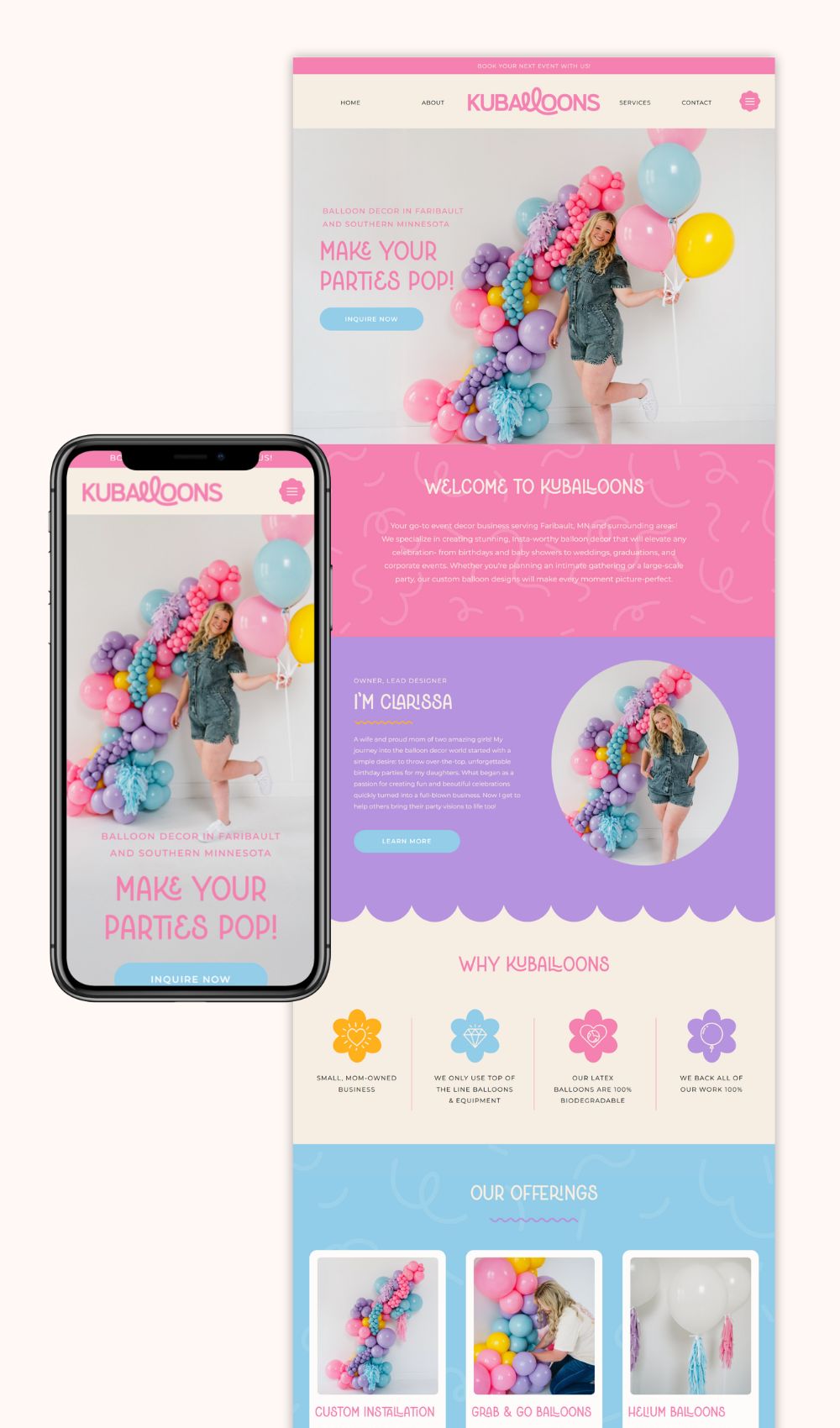
DIY Doesn’t Mean Cheap — It Means Smart
There’s a misconception in the creative business world that doing your own website means settling for something mediocre. That couldn’t be further from the truth. Doing it yourself means you’re being strategic about where you invest your money right now. Maybe you’re in your first year of business and you need to put your budget toward supplies, insurance, and marketing. Maybe you’re a few years in but you just invested in a new van or new equipment. Whatever the reason, choosing a template over a custom build is not settling. It’s a smart business decision.
A well-designed template on the right platform will outperform a poorly built custom site every single time. I’ve seen event planners spend thousands on custom websites built on the wrong platform, with no SEO strategy, no clear calls to action, and layouts that look beautiful but don’t actually convert visitors into clients. A well-built template on Showit with proper structure, SEO-friendly headings, and strategic layout will run circles around that.
Templates are also a great starting point even if you do plan to go custom eventually. They give you a professional online presence right now, today, so you can start showing up on Google and start collecting inquiries while you save up for a fully custom build down the road. Think of it as the foundation you build on, not the ceiling you’re stuck under.
And honestly, some of the event planners who’ve purchased our templates have customized them so beautifully that you’d never know they started with a template. When you put your own photos, brand colors, and copy into a well-structured design, it becomes yours. That’s the whole point.
Why Showit Is the Best Platform for a DIY Website
If you’re going to build your own website, the platform you choose matters more than almost anything else. I’ve worked with event planners who started on Wix, Squarespace, WordPress.org on their own, and GoDaddy Website Builder, and the number one reason they come to me is because they hit a wall. Either the design was too rigid, the SEO wasn’t working, or they couldn’t get their site to look the way they wanted without hiring a developer.
Showit solves all of those problems. It’s a true drag-and-drop builder, which means you can move any element anywhere on the page. There are no locked grids, no rigid columns, no “close enough” compromises. If you want a photo overlapping a text box with a colored shape behind it, you just do it. That kind of design freedom is what makes your site look custom even when it started as a template.
But here’s where Showit really separates itself from the competition: it connects directly with WordPress for blogging. That means your blog posts are powered by the same platform that runs over 40% of the internet. WordPress is the gold standard for SEO, and when your blog lives on WordPress, Google indexes and ranks your content far more effectively than it would on a Squarespace or Wix blog.
Showit also has genuinely excellent customer support. Real humans who answer your questions quickly and actually help you solve problems. When you’re DIY-ing your website, that kind of support is invaluable. You’re not stuck reading through a library of help articles hoping to find the answer on your own.
Want a deeper look at why Showit is the right choice? Read our full comparison post on why Showit is the best website platform for event planners and balloon artists.
The Best Event Planner Website Templates for DIY’ers
Every template in our shop was designed specifically for event planners, party stylists, and balloon artists. They’re not generic business templates that you have to force into working for your industry. The layouts, the page structure, the placeholder copy — it’s all built around how your clients think and what they need to see before they book. Each one is fully customizable and comes with a setup guide so you can get your site live fast.
The Party Planner Website Template
This is the template I recommend most often to event planners who are building their first website. It’s clean, polished, and professional without being stiff or corporate. The layout walks visitors through your portfolio, your services, and your testimonials in a natural flow that builds trust at every scroll. There’s a clear path to your contact form, which means visitors don’t have to hunt around to figure out how to reach you.
The Party Planner template works beautifully whether you’re a solo planner just getting started or an established business that needs a more polished online presence. It’s the kind of design that makes clients feel confident in you before they ever pick up the phone.
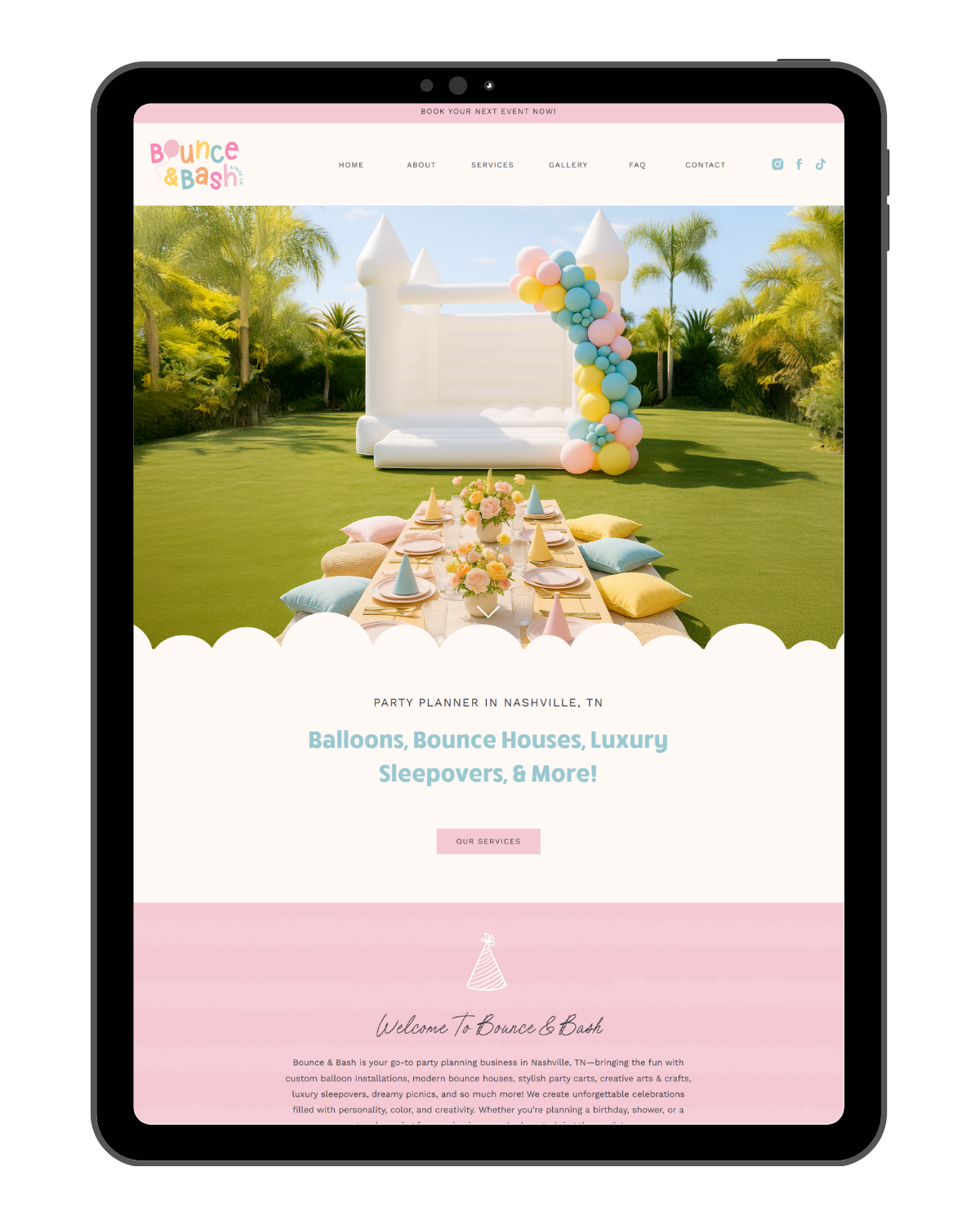
Celebrate Website Template
If your brand is bold, colorful, and full of energy, Celebrate is the one. This template was designed for event pros and balloon artists whose work is vibrant and eye-catching, and the design matches that energy. Big color blocks, dynamic typography, and plenty of space for your portfolio images to really shine.
What I love about Celebrate for DIY’ers is that it’s high-impact without being complicated. The structure is straightforward, which means you can swap in your own content quickly without getting overwhelmed by a complex layout. The boldness comes from the design itself, not from needing advanced skills to set it up.
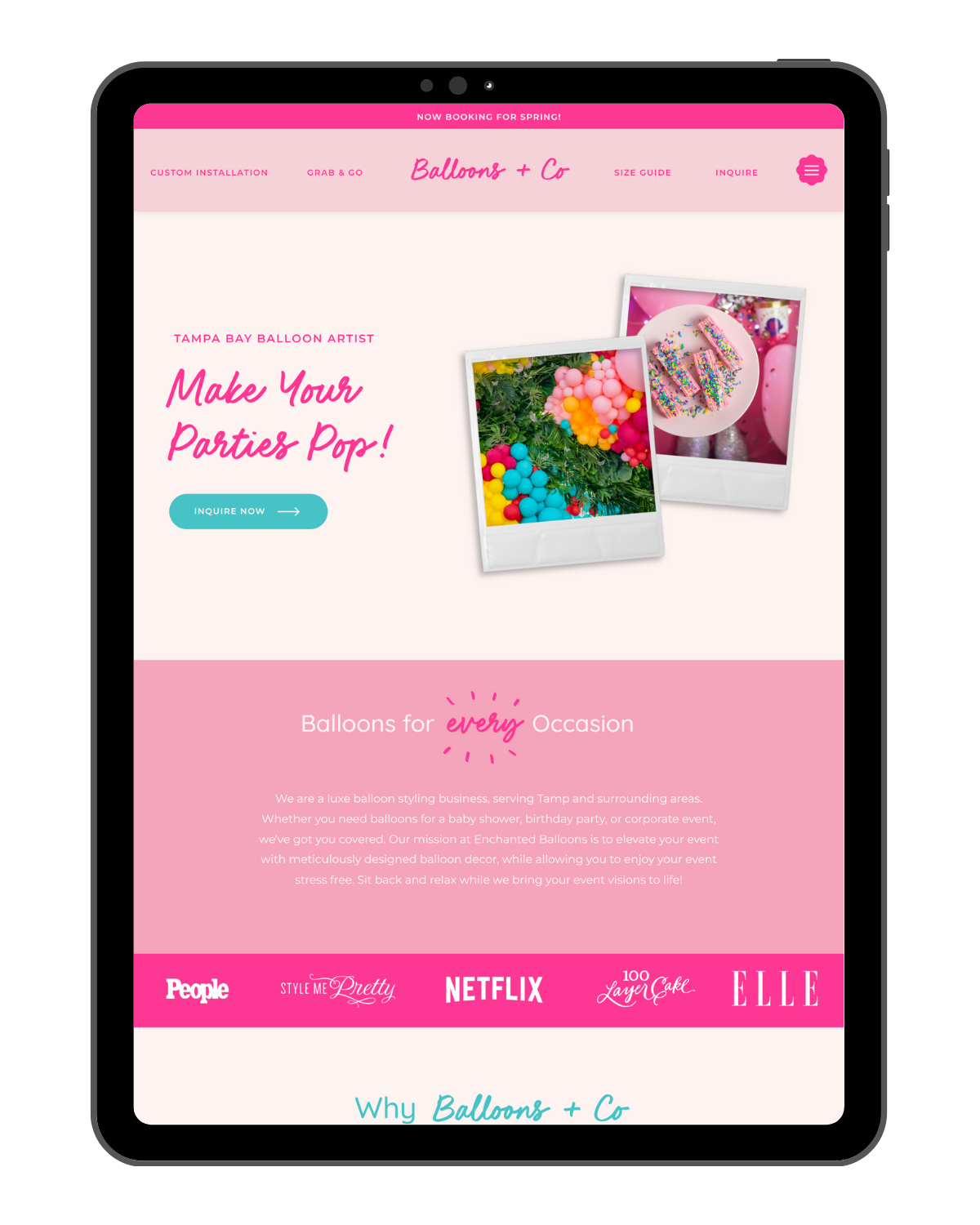
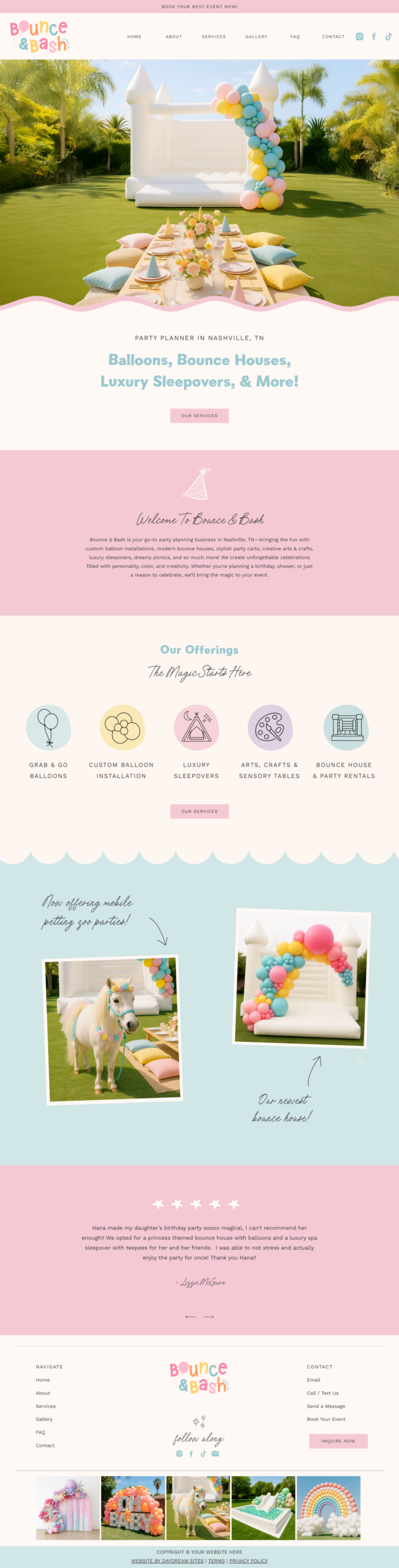
Bright & Happy Website Template
Playful shapes, warm colors, and a layout that feels joyful the moment someone lands on it. Bright & Happy is perfect if your ideal clients are families planning birthday parties, baby showers, gender reveals, or kids’ events. The whimsical design puts visitors at ease immediately, which is exactly what you want when someone is planning a celebration.
For DIY’ers, this template is especially forgiving when it comes to photos. The playful design elements and colorful accents do a lot of the heavy lifting visually, so even if your portfolio photos aren’t professionally shot, your site will still look polished and put-together. That’s a huge advantage when you’re just starting out and may not have a deep library of professional images yet.
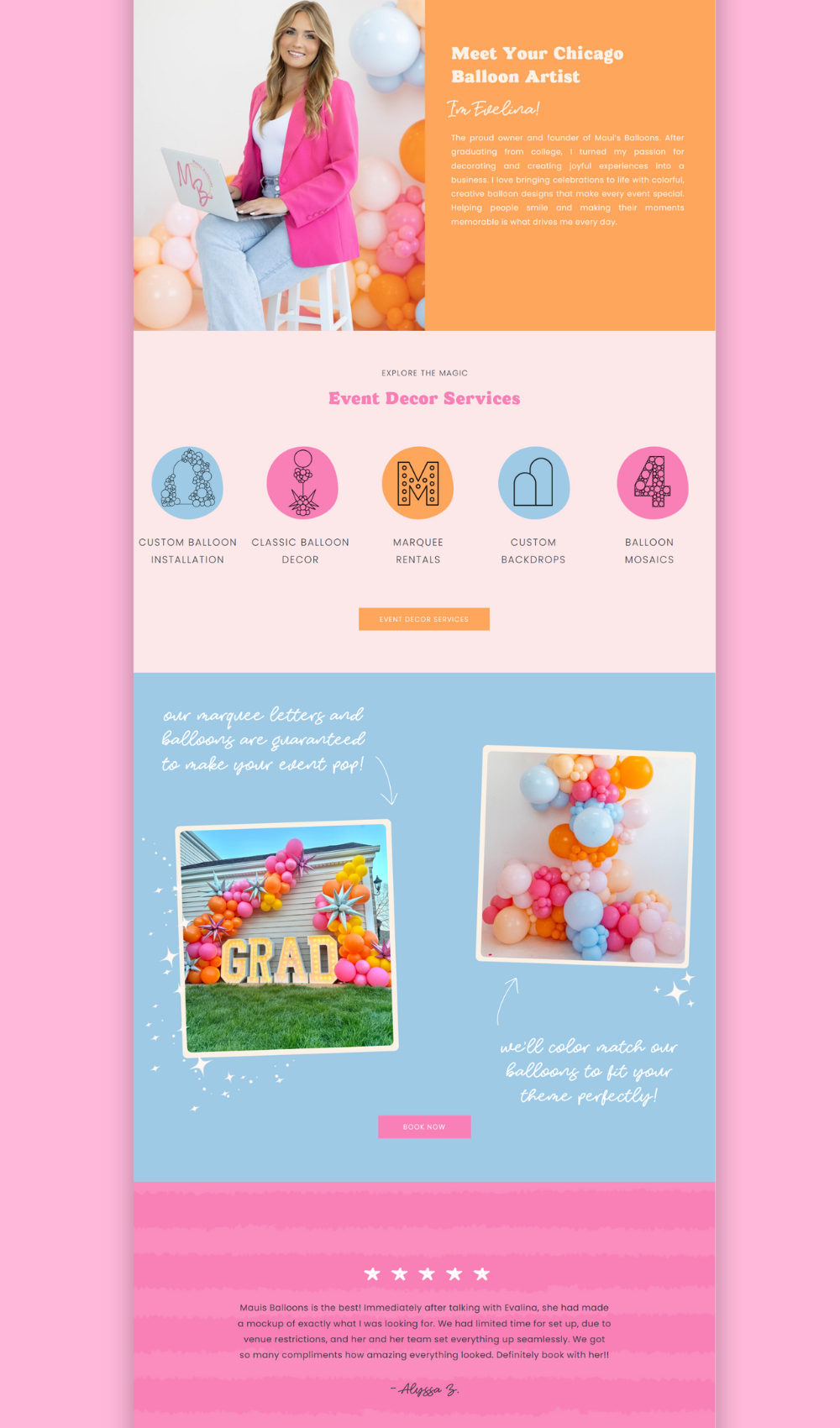
What Makes a Website Actually Book Clients
Having a website is step one. Having a website that converts visitors into booked clients is the real goal. Whether you’re using a template or a fully custom build, there are certain elements that separate a site that just “exists” from one that actively brings in revenue.
A headline that speaks to your ideal client. Your homepage headline is the first thing visitors read, and it needs to do more than just say your business name. It should clearly communicate what you do, who you serve, and where you’re located. “Balloon Installations and Event Styling for Celebrations in Houston” is infinitely more effective than “Welcome to [Business Name].” It tells the visitor they’re in the right place, and it tells Google what your site is about.
Portfolio images that sell the experience. Your photos are your most powerful sales tool, full stop. Every template in our shop has dedicated portfolio and gallery sections because your work needs to be front and center. Clients want to see what their event could look like, and great photos create an emotional connection that words alone can’t match.
A services page that answers questions before they’re asked. Your visitors want to understand what you offer, what’s included, and what the process looks like. The easier you make it for someone to understand your services without having to send a message and wait for a reply, the more likely they are to actually reach out. Include service categories, what’s included in each, and a clear call to action like “Request a Quote” or “Check Availability.”
Testimonials placed strategically, not just on one page. Social proof is most powerful when it shows up at the moments your visitor is making a decision. That means testimonials on your homepage, your services page, and near your contact form. Every time someone is about to think “but is this person actually good?” they should see a glowing review right there.
A contact form that’s easy to find and easy to use. This sounds obvious, but you’d be surprised how many event planner websites bury their contact form three clicks deep or make it so long that people give up halfway through. Keep your inquiry form short and sweet, and make sure every single page on your site has a path to it.
SEO-optimized copy throughout. If your website copy doesn’t mention your city, your services, and the types of events you specialize in, Google has no way to connect your business to local searches. Phrases like “balloon artist in [city]” and “event planner serving [area]” need to be woven naturally into your headings, paragraphs, and image alt text. This is how you show up when someone nearby is actively looking for what you offer.
Want to dive deeper into getting found on Google? Read our full guide on how to get your event planning business to show up on Google.
How to Make a Template Feel Totally Custom
This is the part that most DIY’ers worry about. “Won’t my site look like everyone else’s?” The short answer is no, not if you put a little intention into your customization. Here’s how to take a template and make it feel completely yours.
Start with your brand colors and fonts. The fastest way to transform a template is to swap the placeholder colors and fonts for your own. If you already have brand guidelines, plug them in. If you don’t, choose two or three colors that feel like your business and a font pairing that matches your vibe. This single change will make the template look dramatically different from the demo.
Use your own photos everywhere. Placeholder images are just that: placeholders. The moment you drop in your real event photos, your portfolio, and your own headshot, the site transforms. It stops being a template and starts being your brand. If your photo library is limited, start with your best 10 to 15 images and build from there.
Write copy that sounds like you. Every template comes with placeholder text to give you a starting point, but the magic happens when you replace it with your own words. Write the way you talk to clients. If you’re warm and casual, let that come through. If you’re more polished and editorial, go that direction. Your voice is what makes your site memorable.
Rearrange sections to match your priorities. Showit lets you move sections around on any page. If testimonials are your strongest selling point, move them higher on the page. If your portfolio is what closes deals, make sure it’s visible without scrolling. The template gives you the building blocks; you decide the order.
Add a blog and start posting. This is where most DIY’ers leave money on the table. Your Showit template connects to WordPress for blogging, and even publishing one post a month about your services, your process, or events you’ve styled will start building your Google visibility over time. A blog turns your website from a static brochure into a living, growing marketing asset.
When You’re Ready for More
A template is a fantastic starting point, and for many event planners, it’s all they ever need. But if you reach a point where you want something fully tailored to your brand, we’re here for that too. Our Website in a Week service gives you a completely custom Showit site with SEO baked in, built and launched in five business days. It’s perfect for planners who’ve outgrown their template or who want a site that’s built from scratch around their specific business goals.
We also offer an SEO Accelerator for event planners who have a great website but aren’t showing up on Google yet. This service builds out local landing pages, optimizes your existing content, and creates a keyword strategy so you start ranking for the searches that matter most in your area.
And if your brand identity needs a refresh before your website can truly shine, we do brand and logo design too. Sometimes the thing standing between you and a website you love is a brand that actually feels like you.
Not sure where to start? Browse all our templates in the template shop, or let’s work together and tell me where you are in your business. Whether you’re just getting started or ready to level up, there’s a right next step for you, and I’d love to help you figure out what it is.
View comments
+ Leave a comment
|